QR Code Ordering at Peak Hours: When the Kiosk Has a Queue
Find out what to do when your self-service kiosks are crowded

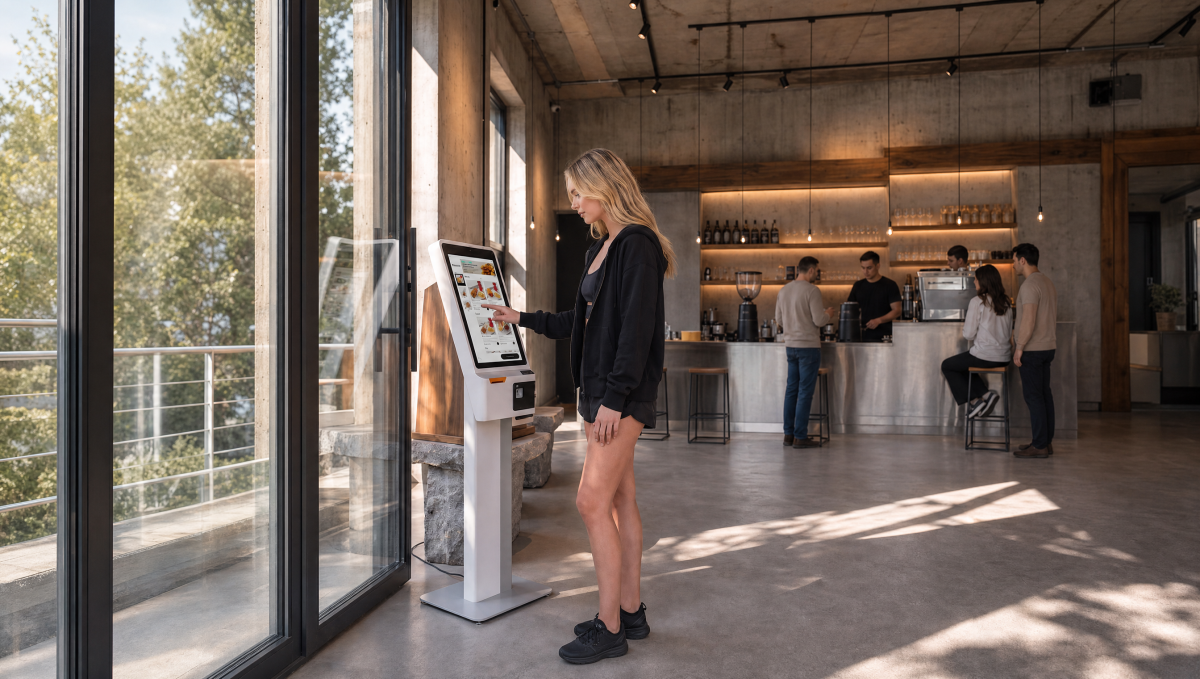
Skip the line by Eatery Club
A restaurant installs two self-service kiosks. The counter breathes again, orders flow — until the first packed Friday. At lunchtime there are four people at each terminal, and someone at the back of the queue walks out without ordering. The kitchen, meanwhile, could be cooking more: the demand is there, the capacity is there, but the order never reached it.
A kiosk, like any physical device, has a throughput limit. QR code ordering gives the queue a way around it: the guest scans a QR code next to the terminal and places the same order in their own phone’s browser. The kiosk stays where it is — it just stops being the only door in. At Eatery Club this runs as Skip the Line, an extension of the kiosk rather than a separate product.
A study in the Journal of Operations Management tracked 94,404 guests at a single restaurant over twelve months. The longer people waited, the more often they left, the later they came back, and the less time they spent in the venue. In a simulation with no waiting at all, the same restaurant would have earned almost 15% more. The study was about waiting for a table, and it promises no one “+15%” for installing a kiosk — but it puts the scale of the problem in plain numbers: a queue is lost demand, not just irritation at the door.
Look closely and a restaurant has several queues:
- before the order — the guest waits for a free counter or terminal;
- during ordering and payment;
- after payment — while the kitchen cooks and hands over.
The last one is bounded by production, and that limit is honest. The first two are often bounded simply by the number of screens. When people are standing in front of the kiosks while the kitchen runs with capacity to spare, the restaurant is losing orders at the most expensive point — between a guest’s intent to buy and the “Pay” button.
What Skip the Line actually does
The flow is short:
- the guest scans a QR code next to the kiosk;
- the restaurant’s menu opens on their phone;
- they build a basket, pick modifiers, and pay online;
- after payment they see an order number and head to pickup.
While ten people share two terminals, the eleventh has already sent their order from a phone.
The phone doesn’t turn into a till — it becomes one more ordering interface. For throughput, that’s enough: the number of order points is no longer hard-wired to the amount of hardware you bought. At peak, the channel grows with the flow of guests — for as long as payment, kitchen, and pickup can keep up.
The kiosk and the phone do different jobs. The kiosk is visible from across the room: it shows the menu, teaches guests to self-order, and serves those who’d rather not place an order on a personal device. The phone kicks in later — at the moment the terminals are busy. The counter stays for advice, cash, and guests who need a hand.
A field experiment at a quick-service restaurant confirms this in a way techno-optimists won’t enjoy: guests rated the kiosk experience higher, yet during busy periods cashiers generated more sales. One restaurant isn’t the whole industry — but it’s reason enough not to write off the human channel yet.
The working model looks like this:
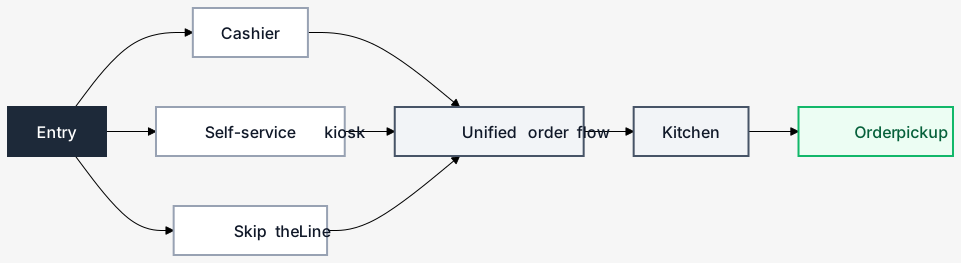
The key word is unified. If the kiosk and the phone show different prices or run on different 86 lists, the restaurant doesn’t get an extra channel — it gets an extra source of errors. A restaurant QR code ordering system is only worth the name when it shares the kiosk’s menu: one set of prices and modifiers, one 86 list, one order-processing pipeline.
That’s how self-service kiosks and Skip the Line are built at Eatery Club — as one system, not two integrations bolted together.
How to measure QR ordering: metrics for a peak-hour pilot
The share of orders placed by phone is a poor starting metric: it grows even when the new channel is merely taking orders away from the counter and the kiosk. Two questions matter more: did the same peak hour produce more paid orders — and did the kitchen cope with them?
Compare before and after launch:
- paid orders per peak hour;
- queue length and waiting time at the counter and kiosks;
- order distribution across counter, kiosk, and phone by time of day;
- conversion from opened menu to payment, and the share of failed payments;
- time from payment to order-ready;
- average ticket by channel on comparable days;
- help requests and technical incidents.
If you launch a discount, refresh the menu, and switch on Skip the Line all at once, the growth can’t honestly be credited to any one of the three. Read the pilot hour by hour, adjusted for traffic, promos, and kitchen load.
The best context is a short, sharp peak: a food court at lunch, fast-casual in the evening, a coffee shop by an office district, a stand at a stadium or an event. The menu is standardized, the terminals saturate quickly, and the kitchen can still absorb an extra stream.
You don’t have to stand in the queue
The kiosk takes the queue off the counter. QR code ordering picks up at the next moment — when the queue forms at the kiosk itself.
Throughput doesn’t become infinite. What changes is this: a guest who is ready to buy stops waiting for access to one of two screens. The order goes from their phone into the shared stream, and the real constraint becomes visible where it can actually be managed — at payment, in the kitchen, and at pickup.
Book a demo — we’ll show you how the kiosk and Skip the Line run on one menu and one order stream.
Published in
Anton Galiukin
Product Owner en Eatery Club. Especializado en innovación digital y crecimiento de producto. Escribo sobre tecnología y la industria HoReCa.
All stories by this author →