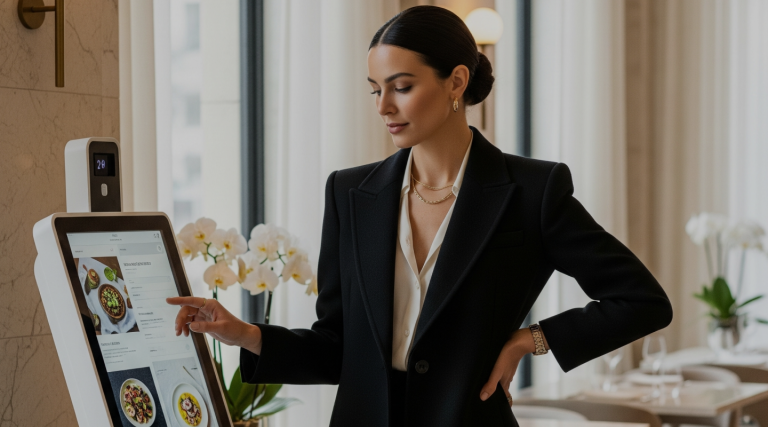
Self-service kiosks in HORECA
How kiosks change order taking and staff roles. Three concerns for restaurant owners, stories about guest service, and reported payback and performance figures.


Photo by Eatery Club
Loading audio…
—:—
On a Saturday evening at a popular fast-food place, the line reaches the door, staff work at their limit, and customers grow impatient. Mark, a sushi chain owner, faced this situation when he first considered self-service kiosks.
“I resisted the idea for a long time,” Mark says. It seemed to him that technology would kill the soul of his establishment. But two years later, he says, revenue was up 35% and customer reviews had improved. Growth alone does not show that kiosks were the cause.
Dozens of restaurateurs have moved from skepticism to enthusiasm in recent years. Reported results include a 20–30% increase in average order value and a four-month payback, but only with proper kiosk implementation.
Self-service kiosks in HORECA: three concerns
“We’ll lose the personal touch”
Anastasia, the owner of a café chain, nearly wept at the first meeting: “This is a family business. Our employees know regular customers by name. How can I replace them with machines?”
After the kiosks were installed, her employees stayed, but their work changed. Instead of taking orders at the register, they began greeting guests at the entrance, helping with kiosks, bringing orders to tables, and talking with customers. “Our clients say service has become more personal,” Anastasia says with a laugh.
“Older customers won’t manage”
Nearly everyone voices this concern. Only 33% of older people regularly use kiosks, compared with 82% of young people. Those figures do not establish whether someone can learn to use a kiosk.
At one McDonald’s, an older woman approached a kiosk. An employee immediately came over and offered help without being intrusive: “Let me show you how it works!” Five minutes later, she was ordering independently, and the following week she was teaching a friend. “You know what I like most? I can take my time, and nobody’s breathing down my neck,” she said.
Successful restaurants designate “kiosk ambassadors.” Their main task during the first few months is to help guests learn the technology.
“It’s too expensive”
The initial investment in kiosks is substantial. A pizzeria with three locations reportedly saved $54,600 annually on labor after moving staff from the registers to the kitchen. According to the same account, service quality and speed improved because the cooks had extra help.
Moving staff does not guarantee savings on its own; savings must be measured by comparing costs before and after kiosk installation.
Results reported from research
- A 20–30% increase in average order value through visual presentation and the ability to choose additional items without feeling rushed.
- Investment payback in 4–6 months with proper implementation. Four months is the lower end of this range.
- A 40% reduction in order errors compared with manual order taking.
- Higher customer satisfaction through shorter waits.
Published in
Platon Sobko
News Editor at Eatery Club. I write about technology, software, the internet, and science
All stories by this author →